
How to Migrate to a New Loan Management System Without Business Disruption
Updated On : October 2026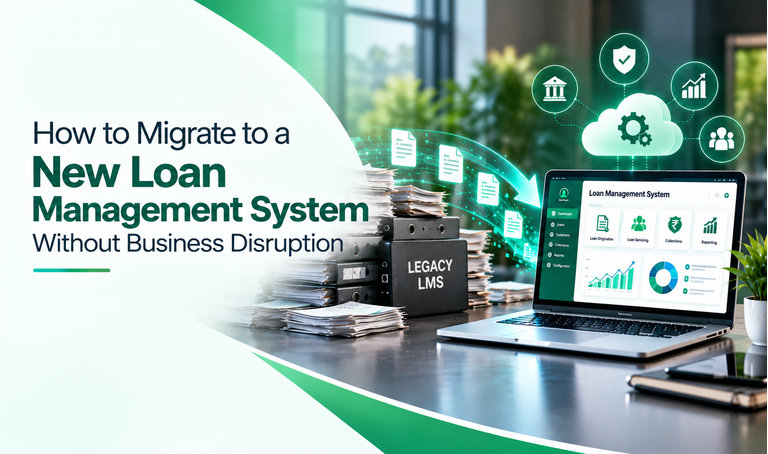
A Loan Management System sits at the heart of lending operations, where customer information, financial transactions, regulatory requirements and operational decisions are continuously managed. Migrating to a new system therefore requires careful planning. While data migration is a major part of the process, the bigger challenge is ensuring that the business continues to operate smoothly while the technology underneath it changes.
For banks, NBFCs and other lenders considering a new Loan Management System (LMS), the safest approach is to treat migration as a business continuity programme, with technology enabling the transition.
Here is a practical blueprint for making the switch.
Map the Business Before Mapping the Database
Start with the lending lifecycle. Map what happens from customer onboarding and credit assessment through sanction, disbursement, servicing, repayment, delinquency, collections, restructuring, write-off and closure. Then map the systems supporting each stage.
A Loan Management System may be connected to credit bureaus, KYC services, payment systems, accounting platforms, CRM applications, collection systems, document repositories and reporting tools.
The Bank for International Settlements recommends that banks identify and map the people, technology, processes, information, facilities and third-party dependencies required to deliver critical operations.
Capture the Business Rules Hiding Inside the Old System
Data and business logic are both important parts of the legacy migration challenge. Over years of customisation, an existing LMS may contain rules for interest calculation, repayment allocation, penalties, restructuring, collateral, overdue classification or product-specific exceptions. Some may be documented, while others may exist only in code or in the knowledge of people who have worked with the system for years.
Deloitte points out that successful modernisation requires organisations to preserve valuable business rules and institutional knowledge embedded in legacy platforms. Before migration, therefore, it is necessary to document the rules that determine how a loan behaves.
Decide What Needs to Move
A migration is also an opportunity to clean up the loan portfolio's data. Separate active loans from closed accounts, identify duplicate customer records, obsolete product configurations and incomplete information, and determine which historical data needs to be retained for audit or regulatory purposes but may not need to sit in the new operational database.
It is also necessary to create a field-by-field mapping between the old and new systems. This is where seemingly small differences can become significant.
Choose the Migration Route Based on Risk
There is no single migration strategy that works for every lender. A big-bang approach moves the entire portfolio at once. A phased approach migrates selected products, branches or portfolios in waves. Another option is to run old and new environments in parallel for a defined period.
The right choice depends on portfolio complexity, integrations, operational tolerance and the organisation's ability to manage coexistence.
Deloitte describes several approaches to banking modernisation, including traditional migration and dual-core coexistence. For a lender, a slower migration that protects business continuity can be considerably more valuable than a faster migration that creates operational risk.
Test the Loan, not Just the Software
A migration can pass technical testing and still fails the business. It is therefore important to test actual lending scenarios.
Take representative loans across products and stages of the lifecycle. Compare opening balances, interest calculations, repayment schedules, part-payments, prepayments, overdue amounts, charges, settlements and closures between the old and new environments.
Then test the connected ecosystem to verify that repayments reach the correct accounts, the accounting system receives the correct entries and collections workflows trigger as expected.
AWS migration guidance recommends testing functional behaviour and dependencies before cutover rather than treating migration itself as the test.
For a lending institution, the real test is whether loans continue to behave correctly after the data is migrated.
Reconcile at More Than One Level
Reconciliation should happen at customer, account, product, branch and portfolio levels. Compare principal outstanding, interest, overdue amounts, repayments, charges and other financially significant balances.
Then sample individual accounts and trace them from source to target. Modern migration tools can perform source-to-target validation at record level and report mismatches. AWS, for example, provides validation that compares source and target rows and identifies records that do not match.
For lenders, reconciliation should become a formal go/no-go criterion.
Rehearse the Cutover
The production environment should never be the first place the migration team discovers how long the process takes. Conduct a full rehearsal using production-like data and infrastructure.
Measure the time required for the final data synchronisation, transaction freeze, backup, validation, integration switch and business verification.
AWS recommends creating a detailed cutover plan, rehearsing it and documenting contingency and rollback procedures before the actual migration. There should also be named decision-makers so that, if something goes wrong, it is clear who has the authority to decide whether to fix forward or roll back.
Design Rollback Around Real Transactions
A rollback sounds straightforward until customers start transacting on the new platform. If a borrower makes a payment after cutover and the organisation subsequently returns to the old system, that transaction cannot simply disappear.
AWS specifically highlights the additional complexity of rollback when new data has already been created after cutover. Depending on the architecture and migration strategy, rollback or recovery approaches may include fail-forward mechanisms, dual-write strategies or tested backup-and-restore procedures.
The important point is that rollback must be designed around data consistency, not merely application availability.
Make the New Platform Ready for the Future
The new LMS should make it easier to introduce products, configure lending rules, integrate external services, manage collections, support multiple channels and generate useful operational information. This is where the architecture of the new platform becomes important.
Nelito Systems' FinCraft™ Loan Management System, for example, supports configurable product rules covering areas such as limits, collateral, recovery appropriation, interest and charges, along with loan servicing, collections, NPA management, restructuring and reporting capabilities.
These capabilities can help lenders replace key legacy functions while providing a more configurable foundation for future lending operations.
Measure the Migration by What Customers do not Notice
The most successful LMS migration may be the least visible one. The customer should still be able to make a repayment. The loan balance should be correct. A disbursement should happen when promised. A collections officer should see the information needed to do their job. Management should be able to trust its reports.
The organisation should also emerge with a platform that is easier to change than the one it replaced.
That is the real test of a seamless switch.
Migration should therefore be measured not only by whether the lender changes its technology without disrupting the business, but also by whether the organisation emerges more agile, resilient and ready for what comes next.
Leave Comments :
© Nelito Systems Pvt. Ltd. Terms & Privacy

Comments :