According to TransUnion CIBIL's March 2025 Credit Market Indicator report, only about 27% of India's credit-eligible population currently uses formal credit facilities. This leaves hundreds of millions of consumers either underserved or outside the formal lending ecosystem. The same report notes that 41% of first-time borrowers are from Gen Z, highlighting the rapid emergence of new borrower segments.
For years, loan underwriting in India followed a predictable process. A lender pulled a CIBIL report, checked the score, ran a few policy rules, and made a decision. Today, that approach is becoming increasingly inadequate.
India's lending ecosystem now relies on four licensed credit information companies (CICs): TransUnion CIBIL, Experian, Equifax, and CRIF High Mark. While CIBIL remains the most recognized name among borrowers, lenders are discovering that relying on a single bureau can leave critical gaps in risk assessment.
For lenders trying to expand credit access without increasing risk, multi-bureau visibility is becoming a necessity rather than a luxury. This shift toward multi-bureau underwriting is a response to changing borrower behaviour, regulatory expectations, and the growing need for more accurate credit decisions.
However, each bureau has its own API structure, response formats, authentication requirements, and data definitions. What appears to be a simple integration project quickly becomes a larger exercise in system redesign. Underwriting rules that once evaluated a single report must now process multiple versions of the same customer's credit history, often with differing data points.
This affects risk models, operational workflows, exception management, and compliance processes throughout the lending lifecycle.
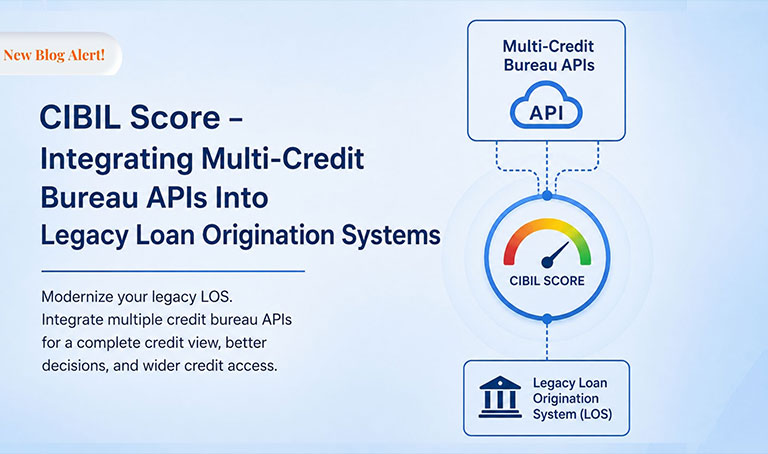
Integrating multiple credit bureau APIs into legacy Loan Origination Systems (LOS) has become one of the most significant technology challenges facing banks, NBFCs, and fintech lenders.
The Problem with a Single Bureau View
Credit bureau data is rarely identical across all bureaus. Credit data can vary across bureaus due to differences in reporting timelines, lender participation, dispute resolution cycles, and data-matching methodologies. A borrower may have an account reflected in one bureau but not another. A recently closed loan may appear updated in one report while continuing to show as active elsewhere. Even credit scores can differ because each bureau uses its own scoring models and calculations.
These differences have become increasingly important as lenders adopt more cautious underwriting practices. Recent industry data indicates that lenders are increasingly focusing on prime borrowers with scores above 730, while the share of new-to-credit borrowers has declined significantly.
A single bureau view may no longer be sufficient to support accurate lending decisions. Multi-bureau integration helps reduce blind spots by providing a broader and often more accurate view of a borrower's financial behaviour.
The Data Normalization Challenge
One of the most critical aspects of multi-bureau integration is data normalization. A lender might assume that a loan account will be described similarly across all credit bureaus. In practice, the same product can be classified differently depending on the bureau. Delinquency indicators, inquiry categories, settlement statuses, and account types may all be represented using different formats and terminologies. Without a mechanism to standardize this information, lenders risk introducing inconsistencies into their underwriting process. Two applicants with similar profiles could receive different outcomes simply because bureau data is being interpreted differently.
To address this issue, many lenders are implementing a bureau abstraction layer within their loan origination systems. Rather than allowing the loan origination system to interact directly with each bureau, a middleware layer receives bureau responses, standardizes the information, and converts it into a common internal format before passing it to underwriting engines. This approach significantly simplifies rule management and reduces the need for constant modifications whenever a bureau changes its API specifications.
The Emergence of Bureau Orchestration
The most advanced lenders are moving beyond integration toward what is increasingly known as bureau orchestration. Traditionally, lenders either queried a single bureau or pulled reports from multiple bureaus for every application, both of which have limitations. Bureau orchestration introduces a more intelligent model. Instead of treating every application the same, the system determines which bureau to access based on the borrower profile, product category, risk segment, and underwriting requirements.
For example, a borrower with a strong credit history may require only one bureau check. A new-to-credit applicant or an MSME borrower, however, may trigger additional bureau requests to gather a more complete credit picture. High-value loan applications may automatically invoke cross-bureau verification to reduce underwriting risk. This approach enables lenders to improve decision quality while controlling bureau-related expenses.
Regulatory Changes Are Accelerating Modernization
Technology investments in bureau integration are also being driven by regulatory developments.
The Reserve Bank of India (RBI) has directed regulated entities to report borrower information to credit information companies on a weekly basis beginning January 2026, replacing the earlier reporting frequency. The move is intended to improve the freshness and reliability of credit information available to lenders.
While the change appears administrative on the surface, it has significant implications for loan origination and credit reporting systems. Many legacy loan origination environments still depend heavily on batch processing and periodic data reconciliation. More frequent reporting increases the need for real-time data synchronization, stronger validation controls, and improved monitoring of bureau interactions. Any data quality issue or reporting failure can now become visible much sooner than before.
Consequently, many lenders are treating bureau integration projects as part of broader modernization initiatives rather than isolated technology upgrades.
New-to-Credit Borrowers Are Changing the Equation
India's expanding credit market is introducing millions of first-time borrowers into the formal financial system. According to TransUnion CIBIL's recent market indicators, younger consumers and borrowers from semi-urban and rural regions continue to contribute significantly to credit growth. For these borrowers, credit information is often fragmented. A consumer may have a small-ticket loan reported to one bureau, a BNPL account reported to another, and a microfinance relationship reflected elsewhere. Viewed individually, these records may not provide sufficient information for an approval decision. Combined, however, they can create a much richer understanding of repayment behaviour and creditworthiness.
This is one reason why lenders seeking growth in underserved markets are increasingly investing in multi-bureau strategies. The objective is not simply to reduce risk but also to identify creditworthy borrowers who might otherwise be overlooked.
Looking Beyond the CIBIL Score
The future of underwriting is moving away from dependence on a single score and toward a more comprehensive model of credit intelligence. Credit bureau data will remain essential, but it will increasingly be combined with Account Aggregator data, banking transaction insights, alternative financial indicators, and internal behavioural analytics. In this environment, the role of the loan origination system evolves from processing applications to orchestrating multiple streams of decision-making data.
For lenders operating on legacy loan origination systems, the implications are clear. Multi-credit bureau integration has become a foundational capability that supports better risk assessment, improved borrower coverage, faster decision-making, and stronger regulatory alignment. The pressing question is whether the existing loan origination systems of lenders are prepared for a lending environment where a single bureau view is no longer enough.
As lenders modernize their lending operations, Loan Origination Systems (LOS) that support seamless credit bureau integration, automated workflows, and configurable decisioning are becoming increasingly important. Nelito Systems' Lending Solutions help banks and NBFCs streamline loan origination, integrate with multiple credit information companies, and build scalable lending operations that can adapt to evolving regulatory and business requirements.


Comments :