
Nelito Systems’ Fincraft™ Core Banking System helps banks modernize their operations with a comprehensive core banking solution that combines cloud-ready architecture, omnichannel banking capabilities, integrated compliance, digital onboarding, and API-driven connectivity, Fincraft™ helps financial institutions build a secure, scalable, and future-ready banking ecosystem. Its flexible architecture also enables banks to integrate with emerging AI and intelligent automation solutions as their digital transformation evolves.
What Is Core Banking Solution (CBS)?
Updated On : August 2026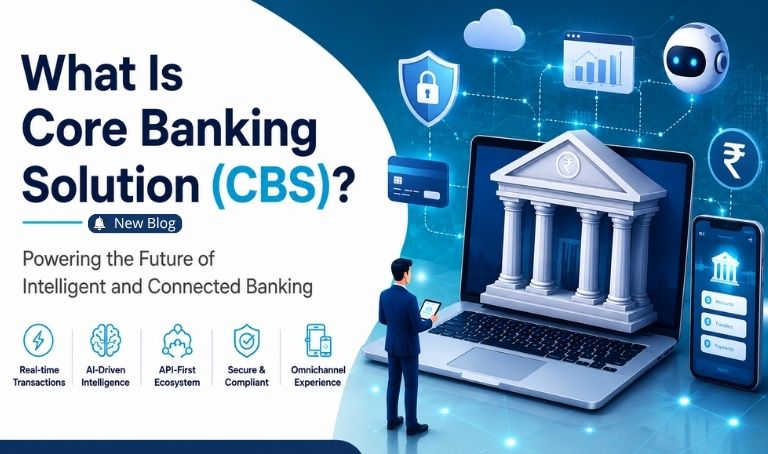
For years, a Core Banking Solution (CBS) was viewed as the operational backbone of a bank, a system responsible for maintaining accounts, processing transactions, managing loans, and keeping records accurate. In 2026, the question is whether the core is capable of supporting an environment where payments happen in seconds, customers expect personalized services instantly, AI agents can execute tasks autonomously, and fintech partnerships are created through APIs rather than lengthy integrations.
The banking industry is witnessing a fundamental shift. Core banking is moving from being a system of record to becoming an intelligent digital platform.
To begin with - what is a Core Banking Solution?
A Core Banking Solution (CBS) is a centralized software platform that enables banks and financial institutions to manage and streamline their core banking operations. This includes account management, transaction processing, loan management, and other essential banking functions. The solution allows customers to access banking services, perform transactions, and manage their accounts seamlessly across branches and digital channels, removing the limitations of branch-specific banking.
In simple terms, a Core Banking Solution is the backbone of modern banking, enabling financial institutions to offer unified, real-time services to customers, regardless of location. This platform centralizes all data, making it easier for banks to manage information and enhance customer experience.
The New Reality: Banking Never Sleeps
The demands placed on banking infrastructure today are unprecedented. India's digital payments ecosystem continues to break records. UPI processed over 23 billion transactions in a single month in 2026, while digital payments now account for virtually all retail payment volumes. Customers expect every transaction, balance update, loan approval, and service request to happen instantly.
For banks, this means that core systems must function as real-time transaction engines capable of supporting continuous availability, high transaction volumes, and seamless customer experiences across every touchpoint. The challenge is particularly significant for institutions operating on legacy architectures that were designed for batch processing rather than always-on banking.
Why Banks Are Modernizing Their Core
Historically, core banking transformation was driven by operational efficiency. Today, modernization is increasingly being driven by growth. Banks want to launch products faster. They want to integrate with fintech ecosystems without lengthy development cycles and offer embedded financial services. They want to leverage AI to improve customer engagement, risk assessment, and operational efficiency. This becomes difficult without if the core banking platform becomes a bottleneck. Modern core banking systems provide the flexibility required to launch new products quickly, integrate through APIs, and support evolving customer expectations without requiring extensive redevelopment.
The Rise of Agentic AI in Banking
The one of the most significant technology trend influencing banking infrastructure today is Agentic AI. Unlike traditional AI systems that provide recommendations, Agentic AI can plan, decide, and execute tasks within defined business rules. Imagine a lending process where an AI agent verifies documents, gathers missing information, evaluates risk indicators, triggers compliance checks, and prepares a decision package for review, all while maintaining a complete audit trail. Or consider a customer service environment where AI agents resolve routine service requests, investigate transaction disputes, initiate corrective actions, and communicate with customers proactively.
These capabilities are rapidly moving from experimentation to production environments. However, Agentic AI is only as effective as the systems it can access. Without a modern core banking platform capable of providing real-time data, workflow orchestration, and secure integration, autonomous banking operations remain difficult to implement at scale. Modern core banking platforms are expected to play an increasingly important role.
From Core Banking to Ecosystem Banking
Another major shift is the emergence of ecosystem banking. Banks are increasingly operating as participants in larger financial ecosystems that include fintechs, payment providers, insurance companies, government platforms, marketplaces, and third-party service providers. In this environment, APIs become as important as branches.
A modern CBS enables seamless connectivity across these ecosystems, allowing institutions to create new revenue streams and deliver services beyond traditional banking channels. The ability to connect quickly and securely has become a competitive differentiator.
Compliance Is Becoming Real-Time
Regulatory expectations continue to evolve. Financial institutions are expected to identify suspicious activities faster, strengthen KYC processes, improve reporting accuracy, and demonstrate operational resilience. Modern core banking platforms are responding by embedding compliance directly into operational workflows rather than treating it as a separate process. This reduces risk, improves visibility, and enables institutions to respond more effectively to regulatory changes.
What Defines a Future-Ready Core Banking Platform?
The next generation of core banking solutions shares several common characteristics:
- Cloud-ready architecture
- API-first design
- Real-time transaction processing
- Embedded compliance capabilities
- AI and Agentic AI integration readiness
- Advanced cybersecurity controls
- Omnichannel customer engagement
- Scalability for high-volume digital transactions
The Road Ahead
The role of core banking is expanding rapidly. As digital payments grow, AI becomes operational, and ecosystem banking gains momentum, financial institutions will increasingly depend on core platforms that can support intelligent, connected, and real-time operations. The banks that succeed over the next decade will not necessarily be those with the largest branch networks or the biggest technology budgets. They will be the ones whose core banking infrastructure enables them to adapt quickly to changing customer expectations and emerging business models.
Leave Comments :
© Nelito Systems Pvt. Ltd. Terms & Privacy

Comments :