
At Nelito Systems, we believe the evolution of India's digital financial infrastructure presents significant opportunities for financial institutions to modernise their operations, strengthen customer experiences and accelerate innovation. With our expertise in banking and financial technology solutions, we help financial institutions navigate digital transformation by building scalable, secure and integrated technology platforms. As India Stack continues to evolve, the focus will increasingly be on translating these digital capabilities into meaningful business outcomes—enabling greater efficiency, agility, financial inclusion and sustainable growth.
India Stack and the Future of Financial Services: Building the Digital Rails for Innovation
Updated On : May 2026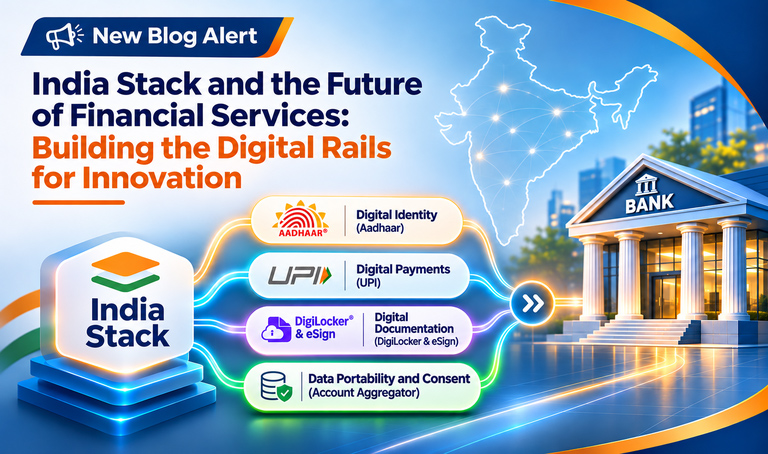
India's financial services industry has spent the last decade digitising products, processes and customer journeys. The next phase of transformation is being driven by shared digital infrastructure that enables banks, NBFCs, insurers, fintechs and other financial institutions to connect and deliver services at scale.
At the heart of this transformation is India Stack—a set of interoperable digital capabilities spanning identity, payments, digital documentation and consent-based data sharing.
Rather than requiring each institution to build these capabilities independently, India Stack provides shared digital rails that can accelerate innovation, improve operational efficiency and expand access to financial services. Its foundational building-block approach has helped foster innovation, competition, financial inclusion and broader economic participation. [1]
For financial services, this changes three fundamental economic factors:
- The cost of acquiring and servicing customers
- The speed at which transactions can be processed
- The amount of information available for financial decision-making
The Four Layers Shaping Financial Services
India Stack is best understood through the capabilities it brings together.
- 1. Digital identity through Aadhaar enables electronic identification, authentication and e-KYC.
- 2. Digital payments through UPI provide an interoperable, real-time payment infrastructure.
- 3. Digital documentation through platforms such as DigiLocker and eSign reduces dependence on physical paperwork and manual verification.
- 4. Data portability and consent through the Account Aggregator framework enables customers to share financial information digitally with regulated entities.
These capabilities address different challenges. Their real value emerges when financial institutions combine them to create connected, seamless and efficient customer journeys.
The scale of India's digital infrastructure demonstrates its reach:
- More than 1.44 billion Aadhaar numbers have been generated. [2]
- DigiLocker had over 71.66 crore registered users and more than 936 crore documents issued as reported in July 2026. [2]
- UPI connected 731 banks and served more than 55.49 crore individuals as of July 2026. [2]
These numbers reflect the scale at which shared digital infrastructure is being used across the country and the potential it offers financial institutions to build and deliver services.
UPI: From Payment Product to Financial Infrastructure
UPI is one of the clearest examples of what shared digital infrastructure can achieve. Before UPI, digital payments were largely built around individual payment instruments, networks and closed ecosystems. UPI introduced an interoperable layer that enables customers to transfer money directly between bank accounts, regardless of the bank or application they use.
Its scale has made instant payments a routine part of everyday life.
For financial institutions, this has raised customer expectations. Transactions are now expected to be instant, available 24/7 and accessible through simple digital interfaces. But the significance of UPI extends beyond payment convenience. Digital transactions also generate records of financial activity.
For a small merchant, hundreds of digital payments each month can provide insights into the volume and consistency of business. Regular salary credits can indicate income patterns, while recurring payments for utilities, insurance or investments can reveal financial commitments.
Taken together, these patterns can provide financial institutions with a richer understanding of customers and businesses. This has implications for credit assessment, fraud detection, customer segmentation and the development of more relevant financial products.
UPI's scale continues to grow. In March 2026 alone, it processed approximately 2,264 crore transactions worth more than ₹29.53 lakh crore. [3]
The value of India Stack therefore moves beyond payment convenience. Digital transactions create information that, when accessed and used appropriately, can support more informed financial services.
Account Aggregator: The Shift from Documents to Data
While UPI has transformed how money moves, the Account Aggregator (AA) framework is changing how financial information moves.
The AA framework enables customers to share financial information between regulated entities through a consent-based mechanism. Instead of asking customers to collect, download and submit financial documents from multiple institutions, a Financial Information User can request relevant information through the AA ecosystem after obtaining the customer's consent. [4]
The ecosystem continues to evolve, with adoption across financial institutions and Account Aggregators. Its growing relevance is particularly evident in lending and financial assessment.
A traditional loan application is heavily document-driven. A borrower submits bank statements, income proofs, tax documents and other information. The lender then spends time collecting, validating and analysing them.
The AA framework enables a fundamentally different model: consented access to financial information that already exists elsewhere in the ecosystem.
For an MSME, this could mean a lender assessing actual banking and cash-flow patterns rather than relying entirely on historical financial statements. For an individual, multiple financial relationships can provide a more complete picture of financial behaviour.
This approach can support faster assessment, potentially reduce documentation friction and enable financial institutions to evaluate customers who may have limited traditional credit histories.
Cash-flow-based lending is particularly relevant for MSMEs, where business activity and cash flows may provide important insights into repayment capacity.
From Financial Inclusion to Financial Participation
India Stack also addresses a longstanding challenge in Indian financial services: the economics of serving customers outside traditional banking segments.
The Pradhan Mantri Jan Dhan Yojana (PMJDY) has expanded access to formal banking. As of 26 August 2026, more than 59.15 crore Jan Dhan accounts had been opened. [5]
A bank account, however, is only the beginning. When a bank account is combined with digital identity, instant payments and consent-based data sharing, customers can participate in a much broader financial ecosystem.
This creates possibilities for:
- Small-ticket and cash-flow-based credit
- Digital insurance distribution
- Faster account and policy onboarding
- Personal financial management
- Automated financial assessments
- More targeted financial products
- Digital collections and recurring payments
The opportunity is particularly relevant for customers who may not fit conventional models of financial eligibility but have sufficient digital financial activity to establish a behavioural profile.
Digital infrastructure can help financial institutions move beyond traditional eligibility models and explore new ways of understanding, serving and supporting customers.
The Business Case for Financial Institutions
The value proposition of India Stack can be viewed across the financial-services value chain.
| Area | Traditional Challenge | India Stack Opportunity |
|---|---|---|
| Customer onboarding | Paperwork and physical verification | Digital identity and e-KYC |
| Payments | Multiple payment rails and fragmented experiences | Interoperable real-time payments |
| Documentation | Physical copies and manual checks | Digital documents and eSign |
| Credit assessment | Fragmented financial information | Consent-based data access |
| MSME lending | Limited formal financial records | Cash-flow-based assessment |
| Collections | Manual follow-up and reconciliation | Digital payment infrastructure |
| Customer servicing | Institution-specific processes | API-led digital journeys |
The gains are not limited to operational efficiency. The bigger opportunity is product innovation.
When identity verification becomes digital, lenders can rethink onboarding. When payments become real-time, businesses can redesign collections. When financial data becomes portable, credit and wealth products can be based on a more comprehensive view of the customer.
The technology is therefore not simply automating existing processes; it is enabling institutions to rethink how financial services are designed, delivered and experienced.
Turning Digital Infrastructure into Business Outcomes
The competitive advantage will not come simply from adopting these digital rails. It will come from how effectively financial institutions integrate them into their operating models.
Institutions that combine digital onboarding, real-time payments, consent-based data access and intelligent analytics can create more streamlined customer journeys, improve operational efficiency and develop products that respond more closely to customer needs.
The opportunity lies in moving from isolated digital capabilities to integrated, end-to-end financial experiences.
For example, a digitally enabled lending journey could combine identity verification, digital document retrieval, consent-based financial data access, automated assessment, digital agreement execution and account-based disbursement.
Similarly, an integrated collections ecosystem could leverage real-time payment infrastructure, automated reconciliation, data-driven reminders and analytics to improve operational performance and customer experience.
The potential impact is significant: reducing friction across the financial-services value chain while creating new opportunities for innovation, scalability and customer engagement.
What Financial Institutions Need to Consider
India Stack does not eliminate the need for sophisticated technology architecture. Rather, it raises the bar.
Financial institutions need API-ready systems, real-time processing capabilities, strong cybersecurity, consent management, data governance and fraud controls to take full advantage of the ecosystem.
There is also an important distinction between access to data and the right to use data.
The Account Aggregator model is built around customer consent. That makes privacy, transparency and purpose limitation central to the business model. This becomes increasingly important as institutions use AI and advanced analytics to derive insights from financial information.
Better data can improve decision-making, but only when it is collected, shared and used responsibly. Institutions must ensure that their digital transformation strategies are built on trust, security, transparency and responsible use of information.
The challenge is not simply integrating digital infrastructure. It is integrating it in a way that is secure, scalable, compliant and aligned with customer expectations.
The Strategic Significance of India Stack
India Stack's greatest contribution may be that it turns essential digital infrastructure into a shared resource, allowing financial institutions to focus their technology and investment on creating differentiated financial products and services.
India's digital public infrastructure approach has attracted international attention. The International Monetary Fund has highlighted how India's foundational digital infrastructure can foster innovation and competition, expand markets, strengthen financial inclusion and improve efficiency. [1]
India Stack has already transformed how Indians identify themselves and move money. For financial services, the next competitive advantage may come from how effectively an institution connects its own capabilities to India's shared digital infrastructure.
The next, more consequential phase may be emerging now—enabling financial information, consent and intelligence to move just as seamlessly. That could reshape not only how financial services are delivered, but who can access them, how risk is assessed and how quickly new products can reach the market.
The opportunity is no longer simply to digitise financial services. It is to build a more connected, intelligent, inclusive and responsive financial ecosystem.
References
Leave Comments :
© Nelito Systems Pvt. Ltd. Terms & Privacy

Comments :