
At Nelito Systems, we understand the evolving technology needs of the banking and financial services industry. Our FinCraft™ Core Banking Solution is designed to help financial institutions streamline banking operations, improve process efficiency and adapt to changing business requirements. With integrated banking capabilities and support for digital transformation, Nelito aims to help banks build more flexible and scalable technology environments. To learn how Nelito can support your banking modernisation journey, explore our FinCraft™ Core Banking Solution.
COBOL Skills Gap: Why Banks Are Modernising Legacy Systems
Updated On : November 2026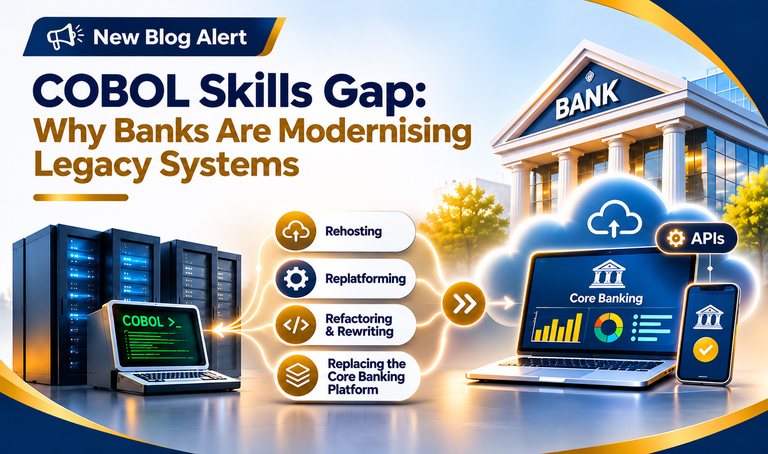
For decades, mainframe computers running COBOL have powered some of the world's most critical banking operations, from processing payments and managing customer accounts to handling loans and deposits. These systems are reliable, secure and capable of handling enormous transaction volumes. However, an ageing technology workforce, rising maintenance costs and growing demand for digital banking are prompting financial institutions to rethink their dependence on legacy infrastructure.
The challenge is not simply replacing old technology. It is preserving decades of embedded banking knowledge while building technology platforms that can support the next generation of financial services.
The Growing COBOL Skills Gap
Developed in 1959, COBOL remains deeply embedded in banking and financial services. Many institutions continue to depend on applications written decades ago, which have evolved through successive modifications rather than complete replacements. Over time, these systems have accumulated complex business rules, dependencies and integrations that are often poorly documented.
The problem is compounded by the shrinking pool of experienced COBOL developers. Many professionals who built and maintained these systems are approaching retirement, taking with them institutional knowledge that cannot always be recovered from source code or technical documentation.
Deloitte identifies the retirement of legacy technology specialists, particularly COBOL programmers, as a significant challenge for banks maintaining existing core systems. The loss extends beyond programming expertise to an understanding of the business rules embedded in these applications.¹
For banks, this creates an operational risk. When only a handful of specialists understand how a critical application works, even routine upgrades, troubleshooting and regulatory changes can become difficult. Attracting younger developers to older programming environments presents another challenge.
Why Banks Are Rethinking Mainframe Dependence
The skills shortage is only one part of the problem. Traditional mainframe environments were designed primarily for high-volume transaction processing, stability and reliability. While these remain essential banking requirements, today's financial institutions need greater flexibility.
Customers expect real-time payments, personalised financial services, seamless mobile experiences and faster loan approvals. Banks also need to integrate with fintech platforms, digital payment networks, analytics systems and third-party service providers.
Connecting older monolithic applications to newer technologies can be complex and expensive. Maintaining legacy infrastructure also consumes resources that could otherwise be directed towards innovation.
Kyndryl's 2025 Mainframe Modernisation Survey, covering banking and financial services organisations, found that 76% had changed their mainframe modernisation strategy in the preceding 12 months. However, the findings also show that banks are not necessarily abandoning mainframes. While 17% reported moving applications to other platforms, 47% were modernising on the mainframe and 26% were integrating it with cloud environments.²
This suggests that modernisation, rather than complete replacement, is becoming the preferred approach for many institutions.
How Banks Are Modernising Legacy Mainframes
There is no single approach to mainframe modernisation. The right strategy depends on the bank's existing infrastructure, transaction volumes, regulatory obligations, application complexity and appetite for operational risk. Broadly, banks are following four approaches.
1. Rehosting: Moving Applications Without Rewriting Them
Rehosting, often called lift-and-shift migration, involves moving existing applications from mainframe infrastructure to another compatible computing environment with minimal changes to the underlying code. This approach can help banks reduce dependence on ageing hardware and infrastructure while retaining familiar application logic. However, it does not eliminate the limitations of legacy code or the need for specialised COBOL expertise.
2. Replatforming: Updating the Underlying Technology
Replatforming involves moving applications to newer infrastructure while making selected changes to improve performance, integration and operational efficiency. For example, a bank may retain its existing COBOL applications but move databases, processing components or selected workloads to modern platforms. This can help introduce cloud capabilities without immediately replacing the core banking system.
3. Refactoring and Rewriting: Transforming Legacy Applications
Some banks are choosing to transform COBOL applications into modern programming languages such as Java. The objective is to make applications easier to maintain, integrate and scale. APIs can connect these services to digital banking channels, payment platforms and third-party applications.
However, banks must identify and preserve the business logic embedded in decades of legacy applications. Incorrectly interpreting even a small business rule can affect interest calculations, payment processing or loan servicing.
4. Replacing the Core Banking Platform
Some institutions are taking a more comprehensive approach by replacing legacy core banking systems with modern platforms. These systems may use modular architectures, APIs and microservices to support faster product development and integration. They can also offer greater flexibility in deploying new banking services.
However, a complete core banking replacement is a significant undertaking. Data migration, application integration, regulatory compliance and uninterrupted transaction processing must all be addressed. For this reason, many banks prefer phased migration over a single large-scale transition.
The Role of AI in Mainframe Modernisation
Artificial intelligence is emerging as an important enabler of legacy transformation. Traditionally, understanding decades-old COBOL applications required extensive manual code reviews, documentation and interviews with experienced developers.
AI-assisted modernisation tools can accelerate this process by:
- Analysing legacy code: Identifying application dependencies, transaction flows and undocumented business rules.
- Automating code conversion: Helping translate COBOL programmes into Java or other modern languages.
- Generating test cases: Identifying potential errors and validating whether converted applications behave like their original counterparts.
- Supporting documentation: Converting complex legacy code into understandable technical documentation, reducing dependence on individual specialists.
However, AI-generated code should not be deployed without rigorous validation. Banks must ensure that transaction accuracy, data integrity, security and regulatory requirements are maintained throughout the transformation.
What Banks Must Consider Before Migrating
Moving away from mainframes is a business-critical transformation that requires careful planning.
- Application and dependency assessment: Banks must identify interconnected applications, interfaces, batch processes and business rules before deciding what to migrate.
- Data integrity: Customer records, transaction histories, account balances and financial calculations must remain accurate throughout migration.
- Regulatory compliance: New infrastructure must meet applicable requirements for data protection, cybersecurity, auditability and operational resilience.
- Business continuity: Migration must be planned to minimise downtime and avoid disruption to essential banking services.
- Cost and scalability: Banks should evaluate the total cost of ownership, including migration, cloud infrastructure, licensing, maintenance and ongoing support.
- Workforce transition: Existing mainframe specialists should be involved in documenting and transferring institutional knowledge, while technology teams develop capabilities in cloud computing, APIs, automation and modern programming languages.
How Nelito Systems Supports Banking Modernisation
Nelito Systems helps financial institutions modernise their banking operations through technology-led solutions designed to support evolving business requirements. Its FinCraft™ Core Banking Solution enables banks to manage key banking operations through an integrated platform, supporting operational efficiency, product flexibility and digital transformation. As financial institutions evaluate their legacy technology environments, modern core banking platforms can play an important role in building scalable, adaptable and efficient banking operations.
The Future of Banking Is Not Necessarily Mainframe-Free
The retirement of COBOL developers has brought an important technology challenge into sharper focus. However, the future of banking will not necessarily involve the complete disappearance of mainframes.
As Kyndryl's 2025 research indicates, banks are pursuing a combination of modernisation, cloud integration and selective migration rather than a universal exit from mainframe environments.
Banks need to reduce dependence on ageing systems and scarce technical expertise without compromising the reliability that their customers and regulators expect. A well-planned modernisation strategy can help financial institutions preserve valuable business logic, improve integration, accelerate innovation and build more adaptable technology environments.
Ultimately, the objective is not necessarily to replace COBOL or eliminate mainframes, but to ensure that the banking systems of tomorrow are not constrained by the technology decisions of yesterday.
Frequently Asked Questions
1. Why are banks modernising COBOL-based systems? +
Banks are modernising COBOL-based systems due to ageing infrastructure, a shortage of experienced developers, rising maintenance costs and the need to support modern digital banking services and integrations.
2. Does mainframe modernisation mean replacing COBOL? +
No. Mainframe modernisation can involve rehosting, replatforming, refactoring, integrating with modern platforms or replacing selected applications. Some banks continue to use COBOL while modernising the underlying infrastructure.
3. What are the risks of migrating legacy banking systems? +
Migration risks include data loss, incorrect business logic conversion, integration failures, operational disruption, security vulnerabilities and regulatory compliance issues. Thorough testing and phased migration can help reduce these risks.
4. How can AI help banks modernise legacy applications? +
AI can help analyse legacy code, identify dependencies, generate documentation, assist with code conversion and support test-case generation. However, its outputs require technical validation, particularly in banking systems.
5. What should banks consider before replacing a legacy core banking system? +
Banks should evaluate business requirements, application dependencies, data migration, integration capabilities, regulatory obligations, operational continuity, scalability, total cost of ownership and workforce readiness.
References
Moving away from mainframes is a business-critical transformation that requires careful planning.
Leave Comments :
© Nelito Systems Pvt. Ltd. Terms & Privacy

Comments :