
For banks evaluating these deployment choices, the capabilities of the core banking solution and the experience of the technology partner are equally important. Nelito Systems brings its experience in banking technology and core banking solutions to this evolving landscape. Banks should evaluate how a core banking solution aligns with their operational requirements, integration needs, security expectations and long-term growth plans before selecting a deployment approach.
SaaS vs. Private Cloud for Core Banking Software: Evaluating TCO and Risk for Large Commercial Banks and Smaller Co-operative Banks
Updated On : November 2026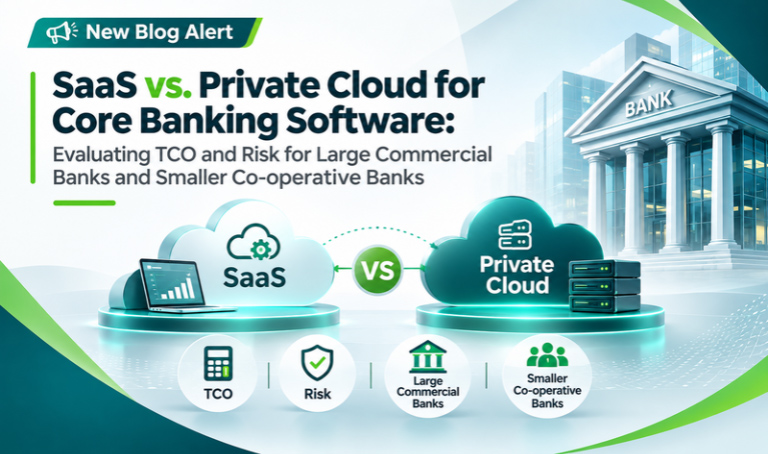
SaaS and private cloud offer banks different approaches to managing core banking costs, infrastructure and operational risks. While SaaS can reduce upfront investment and infrastructure management responsibilities, a private cloud deployment can offer greater control over the technology environment. The right choice depends on the bank's scale, IT capabilities, regulatory obligations and long-term business requirements.
Understanding SaaS and Private Cloud Deployment
Core banking modernisation has become a strategic investment that influences operational efficiency, customer experience, regulatory compliance and a bank's ability to respond to changing business needs.
As banks evaluate deployment options, Software as a Service (SaaS) and private cloud have emerged as two possible approaches. They differ in how software is delivered, hosted, managed, maintained and paid for.
In the SaaS model, banks access core banking software through a subscription or usage-based arrangement. The service provider typically manages the application and underlying infrastructure, including maintenance and upgrades, depending on the service agreement.
Private cloud provides a dedicated cloud environment for a single organisation. It can be managed by the bank or an external provider, offering greater control over infrastructure, configurations, security policies and deployment decisions.
It is important to note that SaaS and private cloud are not mutually exclusive. SaaS describes how software is delivered and managed, while private cloud describes the underlying deployment environment. A SaaS-based core banking application may also operate on a private cloud, depending on the provider's architecture and service offering. Banks should therefore evaluate the service model, hosting environment and management responsibilities separately.[3]
The choice between these approaches is particularly relevant when comparing large commercial banks with smaller co-operative banks, which may have significantly different transaction volumes, technology infrastructure and internal IT capabilities.
Evaluating Total Cost of Ownership (TCO)
The initial software or subscription cost does not represent the total cost of owning and operating a core banking system. Banks must consider the total cost of ownership over the platform's lifecycle, preferably across a five-to-seven-year evaluation period.
The major cost components include:
- Implementation and migration: Software deployment, legacy data migration, testing, integration and employee training.
- Infrastructure: Servers, storage, networking, backup facilities and disaster recovery infrastructure.
- Maintenance and upgrades: Software updates, security patches, technical support and ongoing system maintenance.
- IT personnel: Costs associated with infrastructure management, system administration, monitoring and cybersecurity.
- Security and compliance: Investment in data protection, access management, audits and regulatory compliance.
- Scalability: Additional resources required as transaction volumes, branches and digital banking services expand.
- Exit costs: Data extraction, migration to another platform and transition-related expenses.
SaaS generally reduces upfront infrastructure expenditure and converts a larger portion of technology spending into recurring operational costs. However, subscription fees can increase with transaction volumes, additional modules or changing service requirements.
Private cloud involves greater infrastructure and management responsibilities, but can offer more control over resource allocation and configurations. Its financial viability depends on infrastructure utilisation, maintenance requirements and the bank's ability to manage the environment efficiently.
A meaningful TCO comparison must therefore consider equivalent transaction capacity, availability, security and disaster recovery requirements under both approaches. Banks should also account for potential changes in usage, service requirements and technology needs over the evaluation period.
SaaS vs. Private Cloud: Key Differences
| Parameter | SaaS | Private Cloud |
|---|---|---|
| Deployment | Software delivered as a service, generally through a provider-managed environment | Dedicated cloud environment for a single organisation |
| Initial investment | Generally lower | Generally higher |
| Cost structure | Subscription or usage-based | Infrastructure, licensing and operational costs |
| Infrastructure management | Generally handled by the provider, depending on the service agreement | Managed internally or through an external service provider |
| Maintenance | Generally provider-managed | Depends on the management arrangement |
| Customisation | May be limited by standardised offerings | Greater configuration flexibility |
| Scalability | Capacity can be adjusted through the provider | Depends on infrastructure and resource planning |
| Security | Shared responsibilities between the bank and provider, as defined by the service arrangement | Greater control over the environment, with security responsibilities depending on the management arrangement |
| IT requirements | Lower internal infrastructure management requirements, depending on the service model | Requires technical expertise or managed-service support |
| Vendor dependency | Dependence on the SaaS platform and provider | Dependence on software and infrastructure providers |
Actual responsibilities, costs and capabilities vary depending on the provider, service agreement and deployment architecture. A private cloud environment may also be fully managed by an external service provider.
Understanding Risk and Regulatory Requirements
Cost alone cannot determine the suitability of a deployment approach. Banking systems handle sensitive financial and customer information, making security, business continuity and regulatory compliance essential considerations.
SaaS requires banks to assess data segregation, access controls, provider reliability, data storage locations, subcontracting arrangements and service availability. Dependence on the provider also makes contractual safeguards and exit provisions important.
Private cloud offers greater control over infrastructure and configurations. However, this also requires effective management of cybersecurity, system monitoring, patching, backups and disaster recovery. These responsibilities may be handled internally or through an external service provider.
The Reserve Bank of India (RBI) has reinforced the importance of these considerations through its regulatory framework. Its 2025 Urban Co-operative Banks (Managing Risks in Outsourcing) Directions address outsourcing risks, including material outsourcing of IT services and cloud computing. While the Directions apply to all Urban Co-operative Banks (UCBs), Chapter IV and specified IT-related provisions apply specifically to Tier-3 and Tier-4 UCBs. Banks must assess the applicability of these requirements to their outsourcing arrangements and retain appropriate oversight and accountability for outsourced activities.[2]
The RBI's Information Technology Governance, Risk, Controls and Assurance Practices Directions, 2023, effective from April 2024, establish requirements for applicable regulated entities, including commercial banks. These cover IT risk management, information security, business continuity, disaster recovery and IT audits.[4] Urban Co-operative Banks are subject to their applicable regulatory framework, including the RBI's 2025 outsourcing directions.[2]
Consequently, banks evaluating either approach must examine regulatory applicability, contractual responsibilities, audit access, data protection, incident reporting and recovery arrangements.
Which Model Suits Different Banking Requirements?
Large Commercial Banks
Large banks typically operate complex technology environments involving high transaction volumes, multiple banking channels, extensive integrations and demanding availability requirements.
Private cloud may be attractive where dedicated infrastructure, greater configuration control and integration flexibility are priorities. However, SaaS can also be considered for selected banking functions where standardisation and reduced infrastructure management offer operational advantages.
The decision should depend on the bank's technology strategy, regulatory requirements, existing infrastructure and ability to manage service-provider relationships.
Smaller Co-operative Banks
Smaller co-operative banks often operate with tighter technology budgets and relatively limited in-house IT resources. SaaS can help reduce infrastructure investment, simplify maintenance and provide access to modern core banking capabilities without requiring extensive internal technology teams.
However, recurring subscription costs, connectivity, local support, integration requirements and provider reliability must be evaluated carefully. A managed private cloud solution may also be appropriate where greater control or specific operational requirements justify the investment.
Importantly, co-operative banks are not a uniform category. The RBI classifies Urban Co-operative Banks into four regulatory tiers based on deposit size, with Tier 1 comprising specified smaller UCBs and Tier 4 comprising those with deposits exceeding ₹10,000 crore.[1] Their technology requirements and operational capabilities can therefore vary considerably.
Making the Right Deployment Decision
For lenders, the value of automation lies in connecting loan servicing, repayment monitoring and collections into a coordinated workflow. A suitable loan management solution can help financial institutions manage loan-related processes more systematically and improve visibility across lending operations.
Banks should consider the following factors when choosing between SaaS and private cloud:
- Compare lifecycle costs: Evaluate implementation, infrastructure, subscriptions, maintenance, upgrades and exit expenses over the platform's expected life.
- Assess operational requirements: Consider transaction volumes, branch networks, integrations, availability and future expansion.
- Evaluate IT capabilities: Match the deployment approach with the bank's ability to manage infrastructure, security and ongoing maintenance.
- Prioritise regulatory compliance: Ensure adequate controls for data protection, cybersecurity, audits and business continuity.
- Examine provider reliability: Assess technical expertise, service-level commitments, implementation experience and support capabilities.
- Plan for future flexibility: Evaluate scalability, integration options, data portability and the ability to transition to another platform if required.
Ultimately, the right core banking approach should balance cost, control, security and scalability while supporting the bank's evolving business needs.
References
- RBI – Regulatory Classification Guidelines for Urban Co-operative Banks
- RBI – Urban Co-operative Banks (Managing Risks in Outsourcing) Directions, 2025
- NIST – The NIST Definition of Cloud Computing (SP 800-145)
- RBI – Information Technology Governance, Risk, Controls and Assurance Practices Directions, 2023
Leave Comments :
© Nelito Systems Pvt. Ltd. Terms & Privacy

Comments :