
Nelito’s FinCraft™ Cheque Truncation System supports banks with automated cheque imaging, MICR OCR checking, validation and core banking integration, helping streamline cheque processing while strengthening operational accuracy and control.
How AI-Driven Image Analytics and OCR Enhance Cheque Truncation System Operations
Updated On : November 2026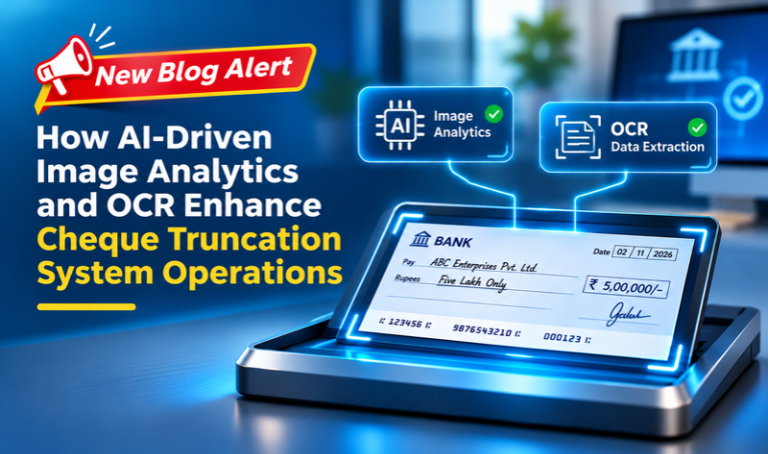
Processing a cheque involves capturing a clear image (as per NPCI standard), extracting critical information, validating details, identifying potential alterations and route it for timely clearance. As cheque processing becomes faster, AI-driven image analytics and Optical Character Recognition (OCR) can help banks improve accuracy, strengthen fraud detection and reduce manual intervention.
From cheque images to intelligent processing
India’s Cheque Truncation System (CTS) transformed cheque clearing by replacing the physical movement of cheques between banks with electronic transmission of cheque images and associated data. According to the Reserve Bank of India (RBI), this approach reduces transportation costs and shortens collection times.
India processed approximately 424 lakh cheques worth ₹6.18 crore in September 2026 alone, underscoring the importance of accurate, efficient and secure cheque processing. At this volume, even small improvements in processing accuracy can make a meaningful difference to operational efficiency.
Digitizing a cheque does not automatically make its contents easy to interpret. Illegible handwriting, poor image quality, overwritten amounts and unusual document features can still create exceptions. AI-driven image analytics help address these challenges.
OCR: Turning cheque images into usable data
OCR converts text within an image into machine-readable information. In cheque processing, it can extract details such as the payee's name, date and amount in words and figures, depending on the system's capabilities.
Traditional OCR works best when text is clear and consistently positioned. Cheques, however, combine handwriting, printed text, security backgrounds and varying layouts. AI-enhanced OCR uses machine-learning models to interpret these variations more effectively.
For instance, when a handwritten amount is difficult to distinguish between two possible values, the system can assign a confidence score to its reading. High-confidence results can proceed to automated validation, while uncertain readings are flagged for human review. It can also help identify discrepancies between amounts written in words and figures or between extracted information and bank records.
This reduces repetitive data entry while directing employees' attention towards transactions that genuinely require judgement.
Image analytics: Looking beyond the text
OCR reads what is written on a cheque. Image analytics examines the cheque itself. AI-driven image analytics can assess image clarity, detect skewed or cropped documents, identify unusual markings and examine visual inconsistencies. These capabilities help banks identify processing problems before they lead to delays or incorrect readings.
Consider a cheque with a potentially altered amount. OCR may read the final figure correctly, but that does not establish whether the instrument has been tampered with. Image analytics can examine suspicious changes in ink patterns, background texture or the area surrounding the amount.
Similarly, signature-comparison models can flag deviations from a reference signature for further examination. Since genuine signatures and handwriting naturally vary, these findings should support established verification procedures rather than independently determine whether a cheque is fraudulent.
Combining AI with fraud detection
Combining OCR with image analytics gives banks a broader view of potential risks. OCR extracts transaction details, image analytics examines visual integrity, and validation rules compare the extracted information with account records and other available controls. Where the Positive Pay System applies, banks can also compare cheque details against information previously provided by the issuer.
The effectiveness of these technologies depends on the quality of data available and how well the different verification mechanisms work together. Combining automated checks with established validation procedures helps banks identify discrepancies and assess potential risks more effectively.
This reads naturally, maintains the original meaning and transitions smoothly from the explanation of OCR, image analytics and Positive Pay.
Faster clearing, fewer bottlenecks
Poor-quality images, unreadable fields and mismatched information can trigger manual intervention, increasing processing time and operational costs. AI-enabled systems can automate image-quality checks, data extraction and exception classification, routing different problems to the appropriate teams.
This capability is increasingly relevant as India transitions to continuous cheque clearing and settlement on realization. The RBI's phased implementation, beginning in October 2025, places greater emphasis on timely processing and confirmation. Intelligent automation can help banks manage these requirements, provided their systems remain reliable and exceptions are resolved promptly.
Integration is key to measurable results
AI and OCR deliver the greatest value when integrated with cheque capture systems, core banking platforms, validation rules, fraud-monitoring controls and audit mechanisms. An isolated recognition engine may extract data accurately but still leave employees managing disconnected systems and repetitive checks.
Banks should establish clear thresholds for automated acceptance, human review and escalation. They must also monitor model performance across cheque formats, handwriting styles and scanning conditions, while ensuring data privacy, security, auditability and explainability.
A phased approach can help - begin with image-quality assessment and OCR-based extraction, measure improvements in accuracy and exception rates, and then introduce advanced anomaly detection. Tracking manual-touch rates, false-positive alerts, processing time and cost per instrument can establish whether the investment is delivering measurable returns.
CTS has already accelerated cheque clearing by eliminating the physical transportation of instruments. AI-driven image analytics and OCR can build on this foundation by making cheque processing more accurate, responsive and intelligent.
For banks, the opportunity lies in connecting image capture, data extraction, validation and risk detection into one coordinated workflow, with appropriate controls and human oversight.
References
Leave Comments :
© Nelito Systems Pvt. Ltd. Terms & Privacy

Comments :